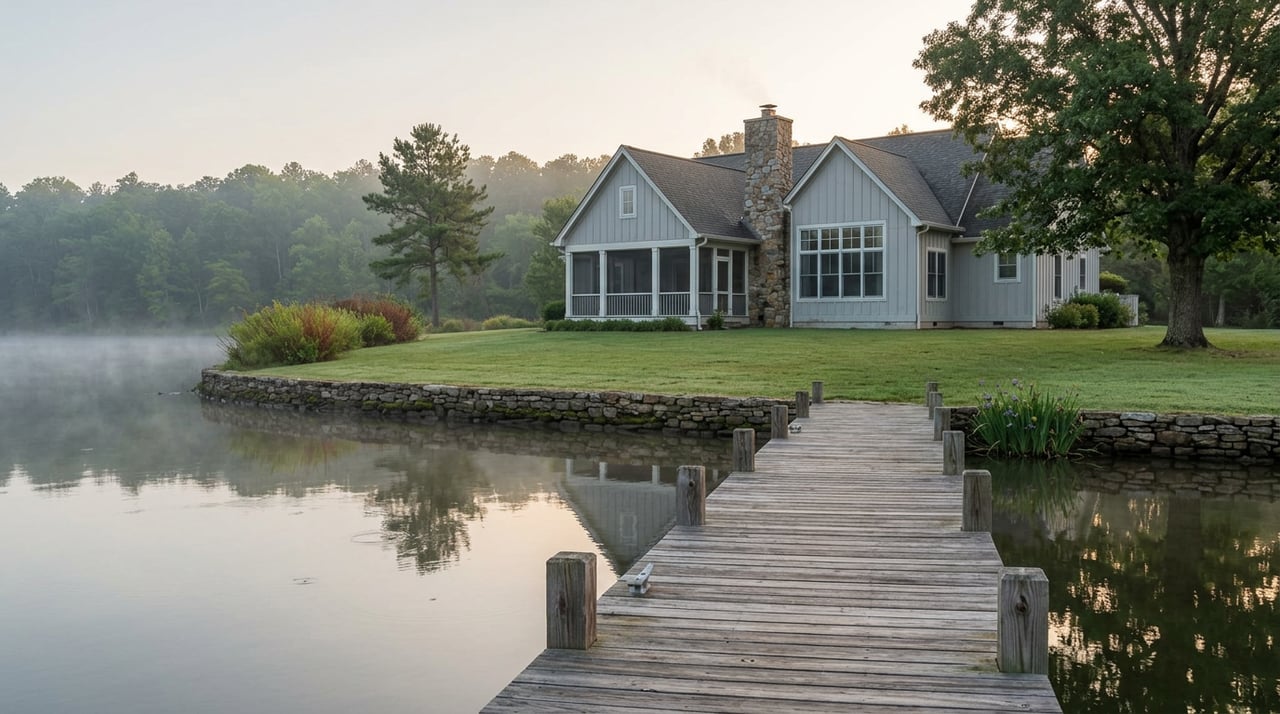
What "Boat Slip Available" Really Means When You're Buying on Green Lake
September 3, 2026
September 3, 2026
Walk down Lake Street past the cleared lot where the Bayview Motel used to sit and you will see the outline of what comes next: The Legacy on the Bay, a new lakeside development bringing seventeen residences to a stretch of shoreline that used to hold a modest motel and its parking lot. The first phase, seven townhomes, has been marketing steadily this year, and every listing carries the same line: direct lake access and boat slip availability.
It is a reasonable thing to want and a reasonable thing to advertise. But if you have spent any time on Green Lake's older shoreline, the phrase should make you pause. A single-family home with a hundred feet of frontage down the shore cannot simply add five more boat slips because five more households want one. So how does a brand-new building, on what was one motel lot, offer that same amenity to seven owners at once, with ten more to come in later phases?
The answer is not marketing. It is Wisconsin water law, and understanding it changes how you should read every waterfront listing on this lake.
Wisconsin's Department of Natural Resources sets a formula for how many boat slips a property can place without an individual permit, and the formula depends on what kind of property is asking.
That second category is the one that matters here. A seventeen-unit condominium building sits squarely inside "three or more dwelling units." The same stretch of shoreline that would cap a single homeowner at two or three slips can, under state rule, support double that count once it is platted as a multi-unit property.
This is why a development built on one former motel parcel can promise a private slip to buyers who, individually, would never qualify for that many docks on that much water. The shoreline itself did not get longer when the motel came down. What changed is the legal category the property falls into. Seven townhomes now sharing that frontage draw from the double-density formula that a family buying the equivalent footage as a single home never could.
It is a genuinely good reason to like a development like this, if you are the kind of buyer who wants turnkey lake access without owning or maintaining a pier yourself. It is also a reason to ask sharper questions than "does it come with a boat slip," because the state's formula tells you how many slips a property is allowed to have, not how they get divided among the people who own units in it.
Picture two properties side by side, each with exactly one hundred feet of Green Lake frontage. One is a single family's cottage, held for three generations. The other is a small multi-unit building. Under the standard formula, the cottage owner can place four slips total for their hundred feet. Under the double-density formula, the multi-unit building can place eight for the identical footage, provided it meets the commercial or three-plus-unit threshold.
Same lake, same amount of shoreline, twice the legal slip capacity. That is the part of the market almost nobody explains before a buyer signs a purchase agreement, and it is worth knowing whether you are the one buying into the new building or the one selling the family cottage next door.
None of this tells you whether a specific unit at a specific development actually comes with an assigned, deeded slip. As of this summer, only four of the seven phase one townhomes at The Legacy on the Bay remained available, with condominium fees still listed as estimated and the condo declaration itself still being recorded. That is normal for a project at this stage of construction, but it also means the exact mechanism for how boat slips get assigned, whether one is guaranteed per unit, held in a shared pool, or offered at additional cost, was not yet finalized in the public record at the time of writing.
If you are looking at a listing anywhere on Green Lake that advertises a boat slip as part of the package, ask for the specific language in writing. A marketing phrase and a deeded, transferable slip right are not always the same document.
The double-density formula only helps you if the property in question is riparian to begin with, meaning it actually owns the shoreline rather than simply having a path to it. Wisconsin law is direct on this point: only a riparian owner can place a pier, dock, or wharf. If a property's deed grants a lake access easement rather than direct shoreline ownership, the easement holder generally cannot build a private pier at all, regardless of how close the water sits.
This distinction matters more on a lake like Green Lake than in newer subdivisions, because so much of the shoreline was platted decades ago, sometimes across generations of the same family, with access arrangements that predate current zoning. Before you fall for a listing description that says "lake access," find out whether that means you will own the frontage or simply have permission to reach it. Your deed, not the listing copy, settles the question.
None of this is arbitrary bureaucracy. Green Lake is Wisconsin's deepest natural inland lake, and it currently carries an impaired water body designation tied to low dissolved oxygen caused by phosphorus loading. The Green Lake Association, the local nonprofit that has spent years tracking the lake's water quality, has stated that meeting the lake's water quality goals will require a reduction of fifty to seventy percent in controllable phosphorus loading. DNR's own permitting standards for new piers explicitly weigh structure placement against fish and wildlife habitat, water quality, and navigation, not just convenience for the property owner.
That context is worth sitting with if you are choosing between a new multi-unit building and an older single-family lot. The state is not simply capping slip counts to be difficult. It is managing a shared, currently strained resource, and the formula that lets a seventeen-unit building out-dock its single-family neighbor exists inside a larger effort to keep the lake itself healthy enough to be worth docking on.
The numbers on the ground reflect all of this friction. As of August 2026, Green Lake's in-town waterfront listings carried a median list price near five hundred thousand dollars and were sitting on the market for an average of about one hundred twelve days. Waterfront listings across the broader county, which includes smaller lakes and river frontage further from downtown, carried a median closer to three hundred twenty-seven thousand dollars and moved in roughly seventy-nine days.
That gap is not simply about square footage or finish level. In-town, walk-to-downtown waterfront on Green Lake proper comes with exactly the kind of due diligence this piece has walked through: riparian status to confirm, slip rights to verify, sometimes a condo declaration still being finalized. Buyers take longer because there is more to check, and sellers who can document their property's actual dock rights clearly, rather than leaving buyers to assume, tend to move through that process with less friction on both sides.
Does buying a unit at a new lakeside condo guarantee a private boat slip? Not automatically. It depends on the condominium declaration and how the developer has assigned slips among units. Ask for that language directly rather than relying on marketing copy.
What is the actual difference between lake access and riparian rights? Riparian rights come with owning the shoreline itself. A lake access easement gives you a path to the water but generally does not include the right to place your own pier. Check your deed, not the listing description.
Can I add more boat slips to an existing single-family waterfront home if I want them? Only up to the standard formula for your shoreline footage, unless your property qualifies as commercial or contains three or more dwelling units. Beyond that, you would need an individual DNR permit, and approval is not guaranteed.
If you are weighing a new lakeside condo against an established waterfront home on Green Lake, the right answer depends on how you actually want to live on the water, not just on what a listing promises. Green Lake Properties has spent years reading these deeds, these declarations, and this shoreline. Contact us before you write an offer, and we will help you understand exactly what you are buying, and what you are not.
Personalized guidance and market expertise designed to help you make confident real estate decisions.
491 HILL ST GREEN LAKE, WI 54941